You know that feeling when a city just grabs you? New Delhi did that to me. Not with grand monuments, but through its pulse—street festivals, temple chants, sudden bursts of dance in alleyways. I didn’t just visit cultural events; I lived them. From spice-scented mornings at local markets to late-night qawwali sessions, every moment was raw, real, and unforgettable. This is immersion, not tourism. New Delhi does not reveal itself to the passive observer. It speaks to those who walk its streets with open hearts, who listen more than they photograph, and who allow themselves to be carried by its rhythm. To truly know this city is to move with it, breathe with it, and let its traditions become part of your memory.
New Delhi is often approached as a checklist of landmarks—India Gate standing tall against the evening sky, the red sandstone walls of the Red Fort echoing Mughal grandeur, the soaring Qutub Minar reaching into history. These sites are undeniably impressive, each one a chapter in India’s long and layered story. Yet, to reduce New Delhi to a tourist itinerary is to miss its beating heart. The city’s true character lives not behind ropes or glass cases, but in the unscripted moments between people—when a shopkeeper breaks into a devotional song, when children wave sparklers during Diwali, when strangers share sweets on a crowded metro. These are not performances for visitors; they are lived realities.
What sets New Delhi apart is the depth of its cultural continuity. Unlike cities where tradition is preserved in museums, here it unfolds daily in homes, streets, and places of worship. To witness this is not enough. Understanding comes from participation—joining a neighborhood kirtan under a banyan tree, clapping along to folk music at a wedding procession, or simply sitting quietly in a gurdwara during langar. These acts create connection. They shift the traveler’s role from outsider to guest, from observer to participant. That shift is where transformation begins.
This kind of engagement requires intention. It means setting aside the camera for moments and reaching instead with curiosity and respect. It means learning when to speak and when to be silent, when to step forward and when to stand back. The rewards are not measured in photos but in moments of recognition—when a grandmother smiles as you try to fold a chapati correctly, or when a young boy teaches you the rhythm of a dhol beat. These are the exchanges that linger long after the journey ends. New Delhi invites not just your eyes, but your presence.
Dawn in New Delhi is not announced by an alarm, but by a chorus of sounds and scents that rise with the sun. Along the banks of the Yamuna River, the soft chime of bells carries from small shrines where priests perform the morning aarti, their hands moving in practiced gestures as oil lamps flicker in the dim light. Nearby, at Gurudwara Bangla Sahib, the aroma of cumin and lentils fills the air as volunteers prepare langar, the community meal served freely to all, regardless of faith or status. This is not charity; it is seva, or selfless service, a cornerstone of Sikh tradition. To eat here is to join a daily ritual that has sustained thousands for generations.
As the sky lightens, the city’s sensory tapestry deepens. In Old Delhi, the alleys of Khari Baoli come alive—a labyrinth of spice merchants whose pyramids of turmeric, saffron, and cardamom glow like jewels. The air is thick with fragrance: dried chilies, cinnamon bark, fenugreek seeds, and the faint musk of camels that once carried goods along ancient trade routes. Shopkeepers shout prices, steel scales clatter, and burlap sacks are heaved onto wooden carts. Yet beneath the chaos is order—a rhythm known only to those who work here. A vendor might offer you a pinch of roasted cumin to taste, or gesture for you to wait while he finishes weighing a customer’s order. These small acts are not gestures of business, but of belonging.
Morning is also a time of devotion. In quiet courtyards, families gather to chant prayers before small home altars. At temples, priests anoint statues of deities with milk and sandalwood paste. Even in modern apartment complexes, the sound of bhajans drifts from open windows. This spiritual undercurrent is not separate from daily life—it is woven into it. To rise with New Delhi is to witness a city grounding itself in ritual before the day’s demands take hold. For the traveler, joining this rhythm—whether by attending aarti, sharing langar, or simply walking the early streets with quiet respect—offers a rare intimacy. It is a reminder that culture is not something you see, but something you feel in your bones.
In New Delhi, festivals are not events on a calendar—they are tides that reshape the city. Diwali, the Festival of Lights, transforms neighborhoods into constellations of flickering diyas and string lights. Homes are cleaned and decorated, doorways lined with rangoli patterns made from colored powder, and families gather to offer prayers to Lakshmi, the goddess of prosperity. The night sky erupts with fireworks, but the real magic is on the ground: children running with sparklers, neighbors exchanging boxes of homemade sweets, and the soft hum of bhajans playing from open windows. To walk the streets during Diwali is to feel joy radiating from every doorway.
Equally powerful is Holi, the Festival of Colors. On this day, social boundaries dissolve. Strangers throw gulal—bright pink, green, and yellow powder—at each other with abandon. Water balloons fly, music blares from rooftops, and laughter echoes through the lanes. While tourists often view Holi as a photo opportunity, for locals it carries deep meaning. It marks the arrival of spring, the triumph of good over evil, and above all, the renewal of relationships. To be invited to a family’s Holi gathering is a gesture of trust. Participation is not required, but a willingness to be playful—and to get very colorful—is appreciated. Even a hesitant smile or a small handful of powder offered in return can open doors to connection.
Republic Day, celebrated on January 26th, offers a different kind of spectacle. The grand parade along Rajpath is a display of national pride, with military contingents, cultural tableaux, and acrobatic performances. But beyond the official event, neighborhoods host their own celebrations—children in school uniforms waving flags, local bands playing patriotic songs, and community feasts. These grassroots expressions of unity are often more moving than the formal ceremonies. For the respectful traveler, attending a local event—rather than just the parade—offers a truer sense of the day’s spirit. Whether it’s Diwali, Holi, or Republic Day, the key to meaningful participation is humility. Ask before taking photos. Accept food when offered. Follow the lead of those around you. In doing so, you move from spectator to guest.
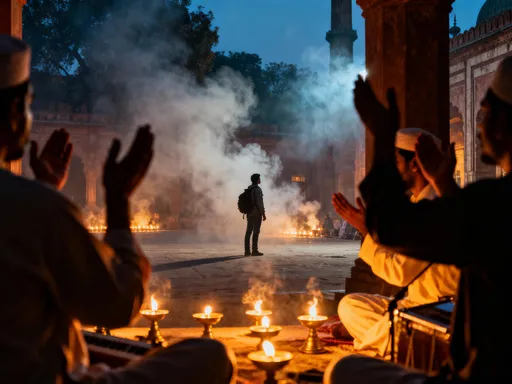
Beyond the well-trodden tourist routes, New Delhi holds quieter, deeper spaces where culture breathes in its most intimate form. In the Nizamuddin neighborhood, the dargah of the 14th-century Sufi saint Hazrat Nizamuddin Auliya hums with devotion every evening. As dusk falls, the courtyard fills with visitors—men in white kurtas, women in colorful dupattas, children clutching offerings of flowers. The air grows still as the first notes of qawwali music rise—powerful, rhythmic, and deeply spiritual. The lead singer’s voice climbs and falls, weaving verses of love and surrender. Listeners close their eyes, sway gently, or raise their hands in prayer. This is not entertainment; it is a form of worship, a centuries-old tradition passed from generation to generation.
Similarly, in hidden corners of Chandni Chowk, artisans keep ancient crafts alive. In one narrow lane, a family has made brass bangles for over a century, their hands moving with precision honed by decades of practice. In another, a bookbinder repairs old Qurans and notebooks with care, using tools passed down from his grandfather. These workshops are not museums—they are working spaces, often passed from father to son. To visit them is to witness heritage in action. Some can be found through local cultural centers or community-led walking tours, which prioritize authenticity over spectacle.
Classical music mehfils, or gatherings, also offer rare access to living art. Held in private homes or small cultural halls, these evenings feature sitar, sarod, or vocal performances in a setting of quiet reverence. There are no tickets, no advertisements—only word of mouth. Attendees sit on the floor, listening intently as the musician explores a raga, building tension and release over hours. The experience is meditative, almost sacred. For the traveler, gaining entry often requires a local introduction, but the effort is worth it. These spaces remind us that culture is not always loud or visible—it can be found in silence, in repetition, in the careful preservation of what matters.
In New Delhi, food is never just sustenance. It is memory, identity, and connection. To eat here is to participate in a web of stories. At street stalls in Chandni Chowk, a paratha vendor flips dough with practiced ease, stuffing it with spiced potatoes, paneer, or even sweet coconut. As he works, he might tell you how his father taught him the recipe, or how a regular customer has been coming since childhood. These exchanges are not incidental—they are part of the meal. The food carries history, and the vendor becomes a storyteller.
Paranthe Wali Gali, a narrow lane dedicated entirely to fried flatbreads, is more than a culinary destination. It is a living archive. Each shop has its loyal following, each recipe a family legacy. Some parathas are stuffed with lentils, others with mashed pumpkin or radish. The oil sizzles, the chappatis puff on the griddle, and customers—locals and visitors alike—stand in line, chatting as they wait. To eat here is to join a daily ritual that has changed little in a century. The experience is not about novelty, but continuity.
Then there is the culture of sharing. At temples and gurdwaras, food is offered as prasad or langar—blessed and free. To accept it is to accept grace. During festivals, families prepare extra sweets—barfi, jalebi, gulab jamun—and send them to neighbors, even those they barely know. This practice, known as distributing ‘mithai,’ strengthens community bonds. Even in modern cafes, the tradition of sharing persists. A cup of chai is rarely drunk alone; it is passed around, sipped slowly, accompanied by conversation. For the traveler, embracing this culture means more than trying new flavors. It means understanding that every meal is an invitation—to sit, to listen, to belong.
New Delhi can be overwhelming. The noise, the crowds, the sheer density of life unfolding in every direction—it can exhaust even the most seasoned traveler. Horns blare, rickshaws weave through traffic, and the air carries a mix of exhaust, incense, and frying spices. This sensory overload is not a flaw; it is the city’s reality. Rather than resist it, the mindful traveler learns to move through it with purpose and presence. The key is not to avoid chaos, but to navigate it with respect and preparation.
Using the Delhi Metro is one of the most effective strategies. Clean, efficient, and well-connected, it bypasses much of the surface-level congestion. It also offers a glimpse into daily life—students in uniforms, office workers reading newspapers, elderly women carrying shopping bags. Dressing modestly, especially when visiting religious sites, shows cultural sensitivity. Covering shoulders and knees, removing shoes before entering temples or gurdwaras, and avoiding public displays of affection are small acts that go a long way. Learning a few basic Hindi phrases—“namaste” for hello, “dhanyavad” for thank you, “kitna hai?” for “how much?”—opens doors and softens interactions.
Equally important is patience. Delays happen. Misunderstandings occur. A rickshaw driver might take a longer route. Instead of reacting with frustration, pause. Breathe. Smile. Often, a calm response leads to a better outcome. Carrying water, wearing comfortable shoes, and planning breaks in quieter spaces—like Lodhi Garden or a local park—help maintain energy. The goal is not to eliminate discomfort, but to use it as a doorway to deeper understanding. When you stop fighting the city’s rhythm and start moving with it, New Delhi reveals its generosity.
The true measure of a journey is not the number of places you’ve seen, but the depth of what you carry back. In New Delhi, that legacy is not a souvenir from a shop, but a feeling—a melody from a qawwali night, the warmth of a shared langar meal, the echo of children’s laughter during Holi. These moments do not fade; they settle inside you, changing the way you see the world. You begin to notice small rituals in your own life—the way your neighbor waves, the rhythm of your morning coffee, the comfort of a shared meal. You see them not as ordinary, but as culture in motion.
This kind of travel is not about distance, but depth. It asks you to slow down, to listen, to engage with humility. It challenges the idea that seeing more means understanding more. Instead, it teaches that one meaningful connection—a conversation with a vendor, a silent moment in a temple, a shared smile with a stranger—can be more transformative than a dozen photo stops. New Delhi does not give up its secrets easily. It reveals itself to those who are willing to step off the path, to be present, and to participate.
When you return home, you may find yourself humming a tune you heard in Nizamuddin. You might start lighting a candle during quiet evenings, not out of ritual, but as a gesture of remembrance. You may feel a new appreciation for the traditions around you, seeing them with fresh eyes. This is the gift of immersive travel—not to collect experiences, but to be changed by them. Let New Delhi’s soul linger. Let its rhythms shape your own. And the next time you travel, go not just to explore, but to belong.

By Rebecca Stewart/Dec 7, 2025
By Lily Simpson/Dec 7, 2025

By Grace Cox/Dec 7, 2025
By James Moore/Dec 7, 2025

By Sarah Davis/Dec 7, 2025
By Benjamin Evans/Dec 7, 2025

By Benjamin Evans/Dec 7, 2025

By Ryan Martin/Dec 7, 2025

By Victoria Gonzalez/Dec 7, 2025
By Jessica Lee/Dec 7, 2025
By Eric Ward/Dec 7, 2025
By Daniel Scott/Dec 7, 2025

By Jessica Lee/Dec 7, 2025
By Emily Johnson/Dec 7, 2025

By Sophia Lewis/Dec 7, 2025

By Christopher Harris/Dec 7, 2025
By Benjamin Evans/Dec 7, 2025
By Laura Wilson/Dec 7, 2025
By Olivia Reed/Dec 7, 2025

By Natalie Campbell/Dec 7, 2025
