Toronto isn’t just Canada’s largest city — it’s a dynamic urban canvas where lakeside views meet steel-and-glass towers. I’ve walked its paths, ridden its elevators, and soaked in its vistas, and let me tell you: the city’s skyline is more than postcard scenery. It’s a living part of the experience. Whether you're chasing sunset reflections over Lake Ontario or hunting for quiet rooftops away from the crowds, knowing where and when to look changes everything. This is your no-fluff guide to seeing Toronto’s cityscape the smart way.
The CN Tower stands as Toronto’s most recognizable structure, piercing the sky at 553 meters and serving as the city’s visual anchor for over four decades. Since its completion in 1976, it has welcomed millions to its observation decks, offering one of the most comprehensive vantage points in North America. From the Main Deck at 346 meters to the SkyPod at 447 meters, visitors gain a layered understanding of the city’s layout — the grid of downtown streets, the ribbon of Lake Ontario, and the suburban sprawl stretching into the horizon. The glass floor, though not for the faint of heart, delivers a thrilling sense of floating above the urban core, connecting viewers physically and emotionally to the city’s verticality.
While the tower remains a must-see, timing your visit can significantly enhance the experience. Midweek mornings, particularly between 9 a.m. and 11 a.m., tend to have shorter lines and fewer crowds, allowing for more relaxed photography and unobstructed sightlines. Sunset hours draw larger groups, but the payoff — golden light washing over the Financial District and the lake catching fire with color — is worth the wait for many. For those seeking value, bundled tickets that include access to Ripley’s Aquarium or the Toronto Zoo can reduce per-attraction costs, especially for families. Additionally, the Tower’s EdgeWalk, though not for everyone, offers an adrenaline-charged way to circle the main pod at height, fully exposed to the elements and skyline.
Yet the CN Tower’s true integration into the cityscape extends beyond its interior decks. Nearby vantage points offer unique perspectives often overlooked by tourists. Roundhouse Park, just west of the tower near the railway lands, provides a low-angle, uncluttered shot of the spire rising against the sky, particularly striking at dawn when mist hovers over the tracks. From CityPlace, a residential neighborhood nestled to the north, the tower appears framed between modern high-rises, illustrating how new developments coexist with iconic landmarks. Even the pedestrian tunnel leading from Union Station to the Metro Toronto Convention Center offers a dynamic, moving view — the tower emerging through glass as you approach, a daily experience for commuters but a delightful reveal for visitors.
Despite the rise of alternative viewpoints, the CN Tower endures because of its unmatched height and centrality. No other location offers such a complete orientation to Toronto’s geography. It remains a symbol of civic pride and engineering ambition, but more importantly, it functions as a reference point from which all other skyline observations are measured. Whether seen from afar or experienced up close, it anchors the city’s visual identity and serves as the starting point for any serious exploration of Toronto’s architectural character.
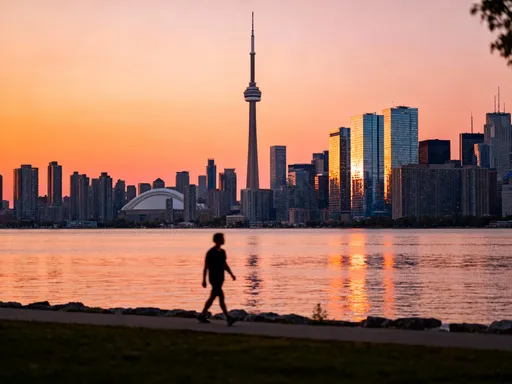
Toronto’s relationship with Lake Ontario is fundamental to its aesthetic and emotional appeal. The waterfront isn’t just a boundary — it’s a stage where the skyline performs daily, reflecting off rippling surfaces and shifting with the mood of the weather. Along the Martin Goodman Trail, a 28-kilometer multi-use path stretching from the Humber River to the Port Lands, pedestrians and cyclists encounter one of the most consistent and rewarding skyline views in the city. From spots like HTO Park and Sugar Beach, the towers rise in a dramatic line, their glass facades mirroring clouds, sunlight, and twilight in ever-changing patterns.
What makes the waterfront unique is its responsiveness to natural conditions. On calm mornings, the lake can become a mirror, doubling the height of the buildings and creating a surreal, symmetrical composition. Foggy days soften the skyline, turning sharp edges into ghostly silhouettes — a favorite among photographers seeking mood over clarity. In winter, when ice forms along the shore, the scene transforms again, with snow-dusted towers standing in contrast to the frozen lake. Even rainfall enhances the experience: wet pavement amplifies reflections, turning sidewalks into liquid canvases.
For those planning a visit, the stretch between Yonge Street and Bathurst Street offers the densest concentration of skyline views. Harbourfront Centre, a cultural hub with public piers and green spaces, provides accessible seating and open sightlines ideal for families or those with mobility considerations. The ferry terminal to the Toronto Islands also serves as an excellent departure point, with the skyline unfolding behind as boats pull away — a perspective that emphasizes the city’s island-like presence on the water.
Timing plays a crucial role. Sunset, particularly in summer and early fall, draws crowds to the eastern end of the trail near Sugar Beach, where the sun dips behind the city, casting long shadows and warm glows across the towers. But early risers are rewarded with solitude and softer light. Weekday mornings often mean having the path to yourself, with only joggers and dog walkers sharing the space. The city feels quieter, more introspective, and the skyline appears less like a spectacle and more like a natural extension of the landscape. For photography, a polarizing filter helps reduce glare, while a tripod — where permitted — captures long exposures of light trails and smooth water.
Beyond the well-known observation decks, Toronto’s skyline reveals itself in quieter, more intimate ways from a growing number of accessible rooftops and elevated public spaces. These spots, often known only to locals, offer a chance to see the city without the press of tourists or the price of admission. The rooftop of the TIFF Bell Lightbox, located on King Street West, is one such gem. Open during public events and select hours, it provides a west-facing panorama that captures the CN Tower, the Financial District, and the emerging towers of the West Don Lands. The angle is unusual — not directly on-axis like most postcard views — and thus feels more authentic, like a glimpse into the city’s working rhythm.
Several downtown hotels also host rooftop bars with skyline access, though a drink purchase is typically expected. The Bisha Hotel’s rooftop lounge and the Delta Hotels by Marriott on Chestnut Street offer stylish settings with unobstructed views, especially compelling at twilight when the city lights begin to sparkle. These venues often have a dress code — smart casual is standard — so visitors should plan accordingly. The benefit of these spaces is not just the view, but the atmosphere: music, conversation, and the gentle hum of the city below create a sensory-rich experience that static observation decks can’t replicate.
Public buildings occasionally offer elevated vantage points as well. The top floors of the Toronto Reference Library on Yonge Street, while not a rooftop, feature large windows with panoramic sightlines northward, capturing the CN Tower framed by seasonal treetops. Similarly, the observation level of the University of Toronto’s Medical Sciences Building, accessible during daytime hours, provides a southward view over the campus and toward the lake, with the skyline emerging between academic structures.
To blend in like a local, timing and demeanor matter. Arriving mid-afternoon at a rooftop bar avoids peak crowds and cover charges, if any. Dressing appropriately — avoiding athletic wear or tourist-heavy accessories — helps maintain the low-key vibe. Most importantly, patience enhances the experience: waiting for a cloud to pass, for a bird to fly across the frame, or for the light to shift can turn a simple glance into a lasting memory. These hidden lookouts don’t just show the skyline — they invite you to slow down and see it with intention.
Toronto’s skyline isn’t confined to designated viewpoints — it appears unexpectedly in the fabric of daily life, revealed through careful urban planning and architectural alignment. Some of the most satisfying glimpses happen at street level, where the city’s towers emerge between buildings, at the end of long avenues, or through gaps in the canopy. University Avenue, for example, is a grand boulevard lined with elm trees and institutional architecture, but it also functions as a deliberate visual corridor. From Queen’s Park northward, the CN Tower appears in the distance, framed by the symmetry of the street, creating a powerful sense of arrival and order.
Other neighborhoods offer more spontaneous reveals. In East Bayfront, a redeveloped industrial area east of downtown, open sightlines allow the skyline to dominate the western horizon. The intersection of Lower Jarvis and Queens Quay, near the Corus Quay building, provides a clean, unobstructed view that feels both modern and serene. The area’s wide sidewalks and public art installations make it ideal for a contemplative walk, with the skyline serving as a constant backdrop.
Even residential districts contribute to the experience. In the Annex, a historic neighborhood near the University of Toronto, narrow streets and heritage homes give way to sudden skyline views when you reach higher ground. From the top of Huron Street, the towers rise above the treetops, creating a striking contrast between old and new. These moments of visual surprise are part of what makes Toronto’s urban experience rewarding — the skyline isn’t always on display, but it’s always present, waiting to be discovered.
Walkability enhances these encounters. Toronto’s grid layout makes navigation intuitive, and many of these vista points are connected by safe, well-maintained sidewalks. Comfortable footwear, a light jacket for breezy days, and a camera or smartphone are the only tools needed. Unlike formal observation points, these street-level views require no tickets or schedules — they’re free, accessible, and woven into the rhythm of the city. They remind us that architecture isn’t just something to look at from afar, but something to move through and live alongside.
The quality of light dramatically shapes how Toronto’s skyline is perceived, making the choice between sunrise and sunset a meaningful one. Both offer beauty, but they deliver different experiences in terms of atmosphere, crowd levels, and photographic potential. Sunset remains the popular choice, drawing visitors to the waterfront and observation decks for the warm hues that bathe the towers in gold and amber. The hour before dusk, known as the “golden hour,” produces soft, diffused light that minimizes harsh shadows and enhances color saturation, making it ideal for photography.
However, sunset also brings larger crowds, especially on weekends and during summer months. Popular spots like Sugar Beach and Harbourfront can become congested, limiting space for tripods or quiet reflection. Additionally, the sun sets behind the city, meaning direct skyline shots often require silhouetting the buildings against the bright sky — a striking effect, but one that demands careful exposure settings.
In contrast, sunrise offers a more serene alternative. The city is quieter, the air often clearer, and the light cooler and more even. From the eastern waterfront, the rising sun illuminates the east-facing facades of the towers, revealing architectural details that go unnoticed at other times. Early morning also provides better visibility for long-distance shots, as overnight cooling reduces atmospheric haze. For photographers, a lower ISO and smaller aperture can capture sharp, detailed images with minimal noise.
From a personal experience standpoint, sunrise fosters a sense of intimacy with the city. There’s a stillness in the air, a feeling of witnessing Toronto before it fully wakes up. Commuters begin to appear, streetlights fade, and the skyline transitions from shadow to light — a gradual reveal that feels more narrative than the abrupt brilliance of sunset. For those seeking a meditative experience or a peaceful start to the day, sunrise may offer the most emotionally resonant view. While it requires an early start, the reward is a skyline seen not as a spectacle, but as a living, breathing part of the urban ecosystem.
One of Toronto’s best-kept secrets is that some of its most dramatic skyline views come not from standing still, but from moving through the city. Public transportation, often seen merely as a way to get from point A to point B, doubles as a dynamic viewing platform. The 510 Spadina streetcar, for instance, delivers a cinematic reveal as it descends the Spadina Avenue hill toward Front Street. From the top, the skyline appears fragmented — glimpses between buildings — but as the streetcar rounds the curve, the full sweep of the Financial District and the CN Tower come into view, framed by overhead wires and historic streetlights.
Similarly, the GO Train’s Lakeshore West line offers a breathtaking approach to Union Station from the west. As the train follows the shoreline, the city rises gradually on the horizon, its towers reflected in the lake. The final minutes before arrival provide a slow, sweeping panorama that no static viewpoint can replicate. Choosing a window seat on the left side ensures the best view, especially during daylight hours. The eastbound Lakeshore East line, traveling toward Pickering, offers a reverse experience — the skyline receding into the distance, growing smaller as the urban core gives way to suburban and natural landscapes.
The subway also provides unexpected moments. Exiting the Union Station platform and ascending to the main concourse, travelers are greeted by a wall of glass that frames the CN Tower directly across the railway tracks. It’s a brief but powerful encounter, reinforcing the tower’s dominance in the city’s geography. Even the PATH underground walkway, while not offering direct views, connects to buildings with skybridges and upper-level windows that peek above street level, offering fragmented but intriguing skyline glimpses during winter months when outdoor access is limited.
What makes transit-based views special is their spontaneity and accessibility. They cost no more than a regular fare, require no reservations, and fit naturally into a day of exploration. They also reflect how locals experience the city — in motion, multitasking, yet still attuned to beauty in the everyday. For visitors, riding these routes with intention — slowing down, looking up, staying on an extra stop — can transform a routine commute into a memorable visual journey.
Toronto’s skyline is not a static image — it evolves with the seasons, shaped by weather, foliage, and light. Each time of year imparts a distinct mood, offering repeat visitors new reasons to return. Winter transforms the city into a crystalline landscape, with snow clinging to rooftops and ice forming along the waterfront. The towers, stripped of foliage, stand in clear silhouette, their geometry emphasized by low-hanging sun and long shadows. Cold, dry air often brings exceptional visibility, making winter an excellent time for long-distance photography. However, frigid temperatures and wind chill require proper clothing — layers, gloves, and a warm hat are essential for extended outdoor viewing.
Spring brings renewal. As snow melts and trees bud, the skyline begins to re-emerge framed by soft greenery. Cherry blossoms along Queen’s Park and High Park add delicate color to the urban palette, contrasting with the steel and glass. The light becomes brighter and more varied, with rapidly changing cloud patterns creating dynamic shadows and highlights. Spring can be unpredictable — sudden rain or late snow are possible — but the sense of transition makes it a compelling time to observe the city’s rhythm.
Summer maximizes vibrancy. Long days mean extended viewing hours, and the skyline glows under intense sunlight. However, humidity and haze can reduce clarity, especially in July and August. Early mornings and evenings offer the best visibility, with cooler air and softer light. The waterfront comes alive with activity — festivals, markets, and outdoor dining — adding human scale to the towering architecture. Fireworks over the lake, particularly on Canada Day and the Canadian National Exhibition, provide spectacular nighttime views, with bursts of color reflecting off glass surfaces.
Fall delivers perhaps the most photogenic conditions. Crisp air enhances visibility, and the changing leaves along the Don Valley Parkway and in downtown parks create a warm, textured foreground. The angle of the sun lowers, casting golden light across west-facing facades in the late afternoon. The contrast between autumn colors and modern architecture produces some of the year’s most striking compositions. For many locals, fall represents the ideal time to explore the skyline — comfortable temperatures, clear skies, and a sense of calm before the winter months.
Understanding these seasonal rhythms allows for better planning. Photographers may target fall for clarity and color, while families might prefer summer for combined skyline and recreational opportunities. Regardless of the season, dressing appropriately and checking weather forecasts ensures a safe and enjoyable experience. More than just a backdrop, Toronto’s skyline is a responsive, living element of the city — one that changes with the turning of the year.
Seeing Toronto’s skyline isn’t just about ticking off landmarks — it’s about understanding the rhythm of the city. With the right timing, locations, and local insight, even familiar views can feel fresh. This guide isn’t just about where to look, but how to see — and truly experience — one of North America’s most underrated urban landscapes. From the iconic CN Tower to hidden rooftops, from waterfront reflections to transit-based reveals, every perspective adds depth to your understanding. Whether you visit in winter’s quiet or summer’s glow, alone at sunrise or with family at sunset, Toronto’s skyline offers more than scenery — it offers connection. Let the city unfold around you, and discover the beauty of seeing like a local.

By Rebecca Stewart/Dec 7, 2025
By Lily Simpson/Dec 7, 2025

By Grace Cox/Dec 7, 2025

By James Moore/Dec 7, 2025

By Sarah Davis/Dec 7, 2025

By Benjamin Evans/Dec 7, 2025

By Benjamin Evans/Dec 7, 2025

By Ryan Martin/Dec 7, 2025

By Victoria Gonzalez/Dec 7, 2025

By Jessica Lee/Dec 7, 2025
By Eric Ward/Dec 7, 2025

By Daniel Scott/Dec 7, 2025

By Jessica Lee/Dec 7, 2025

By Emily Johnson/Dec 7, 2025

By Sophia Lewis/Dec 7, 2025

By Christopher Harris/Dec 7, 2025
By Benjamin Evans/Dec 7, 2025

By Laura Wilson/Dec 7, 2025
By Olivia Reed/Dec 7, 2025

By Natalie Campbell/Dec 7, 2025
