Bukhara, a living tapestry of Silk Road history, reveals its truest self not from guidebooks, but beneath your feet. Walking its sun-baked lanes, I discovered viewpoints where time stands still—ancient domes glowing at golden hour, quiet courtyards whispering centuries-old secrets. These aren’t just scenic spots; they’re emotional waypoints. You don’t see Bukhara—you feel it, one step at a time. And that changes everything. This city, nestled in the heart of Uzbekistan, does not unveil its soul through speed or distance, but through presence, through slowness, through the rhythm of footsteps echoing on centuries-old stone. To walk Bukhara is to journey not only across space, but through time.
Bukhara’s historic center, a UNESCO World Heritage site since 1993, spans over five square kilometers and is one of the best-preserved medieval Islamic cities in Central Asia. Its layout has changed little since the 10th century, a rare testament to urban continuity. The city was a hub of trade, scholarship, and religion along the Silk Road, and its streets still carry the weight of that legacy. But to truly understand Bukhara, one must move through it on foot. Unlike other historic cities where modern development has erased the past, Bukhara’s authenticity lies in its unbroken fabric—its narrow alleys, domed bazaars, and intimate courtyards remain untouched by large-scale reconstruction. Walking allows travelers to notice the small details that define the city’s character: the intricate brick patterns on a 12th-century portal, the hand-carved wooden columns supporting a shaded arcade, or the faint scent of cumin and saffron drifting from an open market stall.
Motorized transport, while convenient, bypasses the sensory layers that make Bukhara unforgettable. The hum of a scooter or the rush of a minibus cannot capture the way sunlight filters through a lattice screen at mid-morning, or how the call to prayer from the Kalon Minaret echoes through stone corridors just before noon. On foot, the traveler becomes part of the city’s rhythm. You hear the clatter of copper being shaped in a small workshop, the laughter of children playing near a mosque entrance, and the soft murmur of elders debating in a shaded courtyard. These moments are not staged; they are lived. They are the heartbeat of Bukhara, and they can only be felt by those who move slowly, who pause, who listen.
Moreover, walking fosters a deeper connection with local life. In the morning, you might pass women balancing baskets of fresh non (flatbread) on their heads, returning from neighborhood ovens. In the late afternoon, shopkeepers lower handwoven cotton awnings to shield their wares from the sun. These routines have persisted for generations, and by walking through them, visitors gain insight into the quiet dignity of daily existence in a city where tradition and modernity coexist. The pace of walking aligns with the pace of life here—measured, intentional, respectful. It is this alignment that transforms sightseeing into something more profound: a quiet communion with history, culture, and place.
Standing at 47 meters tall, the Kalon Minaret is not only Bukhara’s most iconic structure but also one of the tallest surviving minarets from the Islamic medieval period. Completed in 1127 under the Karakhanid dynasty, it has witnessed the rise and fall of empires, survived Mongol invasions, and remained a constant in the city’s skyline. To approach it is to feel the weight of centuries. The base is wide and imposing, built of baked brick in concentric bands of geometric patterns that spiral upward like a stone helix. As you circle it, the craftsmanship reveals itself in subtle shifts—each band a variation on a theme, each brick laid with precision that defies the passage of time.
Climbing the minaret is a rare privilege, offering access to one of the most breathtaking vantage points in Central Asia. A narrow spiral staircase, lit by small arched openings, winds upward through the interior. The climb is steep and requires moderate physical effort, but the ascent is part of the experience—a slow, deliberate journey that mirrors the spiritual elevation the minaret once symbolized. Upon reaching the top, the city unfolds in every direction. To the east, the turquoise domes of the Mir-i-Arab and Ulugh Beg Madrasahs catch the morning light. To the west, the Ark Fortress rises like a citadel from another age. Northward, the bustling trading domes—Toki Sarrafon, Toki Telpak Furushon—mark the commercial heart of old Bukhara. Southward, residential neighborhoods blend seamlessly into the historic core, their flat roofs and courtyard gates revealing a living city, not a museum.
The best time to visit is late afternoon, when the sun begins to lower and casts a golden glow across the adobe buildings. Shadows stretch long across the Po-i-Kalyan plaza, and the temperature cools enough to make the climb comfortable. Visitors should dress modestly—women are advised to wear long sleeves and headscarves, men should avoid shorts—as the minaret remains an active religious site. Photography is permitted, but tripods are often restricted. While the view is panoramic, it is not merely visual; it is emotional. From this height, Bukhara feels both vast and intimate, a city that has grown organically, layer by layer, century by century. You see not just buildings, but stories—of traders, scholars, artisans, and families who have called this place home for generations.
While the Kalon Minaret offers a bird’s-eye view, the true magic of the Po-i-Kalyan complex lies at ground level, within its three monumental structures: the Kalon Mosque, the Mir-i-Arab Madrasah, and the Ulugh Beg Madrasah. Together, they form a harmonious ensemble that has stood since the 16th century, when the Shaybanid dynasty restored much of Bukhara’s architectural grandeur. Standing in the central courtyard, framed by towering iwans (vaulted halls) and flanked by symmetrical madrasahs, one experiences a sense of balance and proportion that is both architectural and spiritual. This is not just a place to look at—it is a place to stand within, to feel the stillness, to absorb the geometry of space and light.
The courtyard itself functions as a natural observation point. From the center, the Kalon Minaret rises perfectly centered, creating a visual axis that draws the eye upward. In the early morning, when the sun is low, the eastern facade of the Ulugh Beg Madrasah is illuminated, revealing the intricate mosaic tiles in shades of cobalt, turquoise, and white. By late afternoon, the western side of the courtyard is bathed in warm light, casting long shadows that trace the patterns of the brickwork. These shifts in illumination transform the space throughout the day, offering different moods and perspectives. Photographers often wait for these golden moments, but even without a camera, the experience is unforgettable.
What makes this vantage point unique is the human presence. Unlike many historic sites that feel frozen in time, Po-i-Kalyan is alive. Students in traditional robes walk between classes at the Mir-i-Arab Madrasah, which still functions as a religious school. Tourists gather near the mosque entrance, listening to guides recount the site’s history. Locals pass through, using the plaza as a shortcut or pausing to rest on shaded benches. This blend of sacred, scholarly, and everyday life gives the courtyard a layered depth. It is not a relic, but a working part of the city. To stand here is to witness history in motion—where the past is not preserved behind glass, but lived in the present.
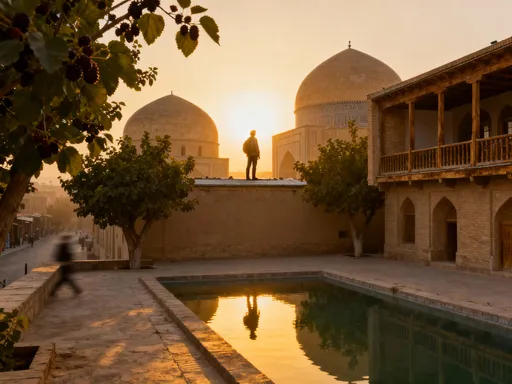
A short walk from the Po-i-Kalyan complex, the Lyabi-Hauz area offers a different kind of perspective—one of quiet contemplation. At its center lies a large rectangular pool, one of the few surviving remnants of Bukhara’s historic water system. Built in the 17th century, the pool was once part of a network of reservoirs that supplied water to caravanserais, madrasahs, and homes. Today, it is surrounded by mulberry trees, their broad canopies providing shade, and traditional teahouses with carved wooden balconies. While the ground level buzzes with activity—musicians playing doira drums, vendors selling dried fruits and nuts—some of the most rewarding views come from above.
Several small guesthouses and family-run cafes in the area offer rooftop terraces that are open to visitors. These spaces are unmarked, unadvertised, and refreshingly free of commercialization. One such terrace, accessible through a narrow staircase behind a modest teahouse, provides a panoramic view of the entire Lyabi-Hauz ensemble. From here, the pool reflects the sky like a mirror, especially at dawn and dusk. The surrounding buildings—former caravanserais turned restaurants, old merchant houses with latticed windows—frame the scene in warm earth tones. It is a view that feels timeless, yet deeply peaceful.
Sipping green tea on one of these terraces, you witness the rhythm of local life unfold below. Elders gather around stone tables to play backgammon, their movements slow and deliberate. Children dart between tables, chasing each other under the watchful eyes of grandparents. In the late afternoon, the light turns golden, and the shadows of the mulberry trees stretch across the water. There are no loudspeakers, no crowds rushing to check a landmark off a list—just the quiet hum of daily existence. For travelers seeking a moment of stillness, these hidden rooftops offer a rare gift: a chance to observe Bukhara not as a destination, but as a home.
A ten-minute walk from Lyabi-Hauz, Chor Minor offers a quieter, more introspective vantage point. The name means “Four Minarets,” though the structure is not a minaret at all, but a former madrasah gatehouse with four slender towers, two of which are topped with blue-tiled domes, and two with conical roofs of yellow brick. Built in 1807 by a wealthy Turkmen merchant, it was once part of a larger educational complex, most of which has not survived. What remains is whimsical, almost playful in its asymmetry, yet deeply serene.
The courtyard inside Chor Minor is small and intimate, open to the sky, with a single tree at its center. Standing here, you feel a subtle sense of elevation—not physical, but psychological. The surrounding buildings are lower, and the noise of the main tourist routes fades away. The air carries the scent of baking non from a nearby oven, and the occasional call of a muezzin from a distant mosque. This is not a place for grand panoramas, but for quiet reflection. The four towers frame different slices of sky, and as the sun moves, light filters through the arched openings, casting ever-changing patterns on the brick floor.
The walk to Chor Minor takes you through residential neighborhoods where life unfolds at a gentle pace. Narrow lanes, lined with blue-painted doors and courtyard gates, lead past homes where laundry hangs in the breeze and cats nap in sunlit corners. Occasionally, a neighbor will smile or offer a quiet greeting. These streets are not part of the main tourist circuit, but they are safe and welcoming. For travelers who have spent days in crowded bazaars and historic squares, Chor Minor offers a return to simplicity. It is a reminder that Bukhara’s beauty is not only in its monuments, but in its ordinary moments—the way light falls on a wall, the sound of a distant hammer shaping metal, the warmth of a shared smile.
For those seeking a structured walking route that combines history, atmosphere, and visual beauty, a sunset walk from the Ark Fortress to the old city walls is unparalleled. The Ark, a massive mud-brick citadel that served as the residence of Bukhara’s rulers for over a millennium, stands at the edge of the historic center. By late afternoon, when the sun begins to dip, the western walls of the fortress glow in deep amber, their texture highlighted by the low-angle light. Visitors are allowed to explore the interior until an hour before sunset, making it an ideal starting point.
From the main gate, a path leads southeast through quiet plazas and along ancient alleyways. One recommended route takes you past the Bolo Hauz Mosque, with its wooden columns and reflecting pool, then through the Tim Abdullah Khan covered bazaar, where artisans still sell handmade goods. As the sun sets, the adobe buildings along the way transform—they seem to radiate warmth, their surfaces shifting from ochre to deep red. Shadows grow longer, and the air cools. By the time you reach the remnants of the old city walls near the Chor-Bakr necropolis area, the sky is often streaked with pink and gold.
This walk is not only visually stunning but also safe and well-lit, as it passes through populated areas with street lamps and occasional shops. It is best done with a local map or GPS, as some alleys are unmarked. The experience is meditative—each step accompanied by the soft crunch of gravel, the distant chime of a bicycle bell, or the murmur of a family gathering for evening tea. Unlike daytime exploration, which can feel hurried, the dusk walk invites slowness. It is a time to reflect, to absorb, to let the city speak in whispers rather than shouts. For many travelers, this hour becomes the most memorable part of their visit—a quiet farewell to a city that has given so much.
In an age of instant photography and rapid travel, it is easy to mistake seeing for understanding. We collect images, check landmarks off lists, and move on. But in a city like Bukhara, true connection comes not from accumulation, but from attention. The viewpoints described here—whether from a minaret, a courtyard, a rooftop, or a quiet lane—are not merely places to take photos. They are invitations to pause, to look deeply, to let the moment settle into memory. Each offers a different lens through which to understand the city: the grandeur of history, the warmth of daily life, the beauty of light and shadow, the peace of solitude.
Walking, as both a physical and philosophical act, shapes how we remember places. When we move slowly, we allow space for emotion, for surprise, for the unexpected encounter—a shared cup of tea, a child’s smile, the sound of prayer at twilight. These moments do not fit neatly into travel itineraries, but they are the ones that linger. They become part of who we are. Bukhara, with its layered history and living traditions, rewards this kind of travel. It asks not for speed, but for presence. It does not reveal itself all at once, but in fragments, in glances, in footsteps on ancient stone.
Ultimately, the best way to know Bukhara is not to see it from above, but to walk through it, to feel its pulse, to let it unfold at its own pace. The city teaches a quiet lesson: that perspective is not just about where you stand, but how you see. To look slowly is to understand deeply. To walk with intention is to travel with meaning. And in a world that moves too fast, Bukhara remains a sanctuary for those who still believe in the power of a single step.
By Rebecca Stewart/Dec 7, 2025

By Lily Simpson/Dec 7, 2025

By Grace Cox/Dec 7, 2025
By James Moore/Dec 7, 2025

By Sarah Davis/Dec 7, 2025

By Benjamin Evans/Dec 7, 2025

By Benjamin Evans/Dec 7, 2025

By Ryan Martin/Dec 7, 2025

By Victoria Gonzalez/Dec 7, 2025
By Jessica Lee/Dec 7, 2025
By Eric Ward/Dec 7, 2025

By Daniel Scott/Dec 7, 2025

By Jessica Lee/Dec 7, 2025
By Emily Johnson/Dec 7, 2025

By Sophia Lewis/Dec 7, 2025

By Christopher Harris/Dec 7, 2025
By Benjamin Evans/Dec 7, 2025
By Laura Wilson/Dec 7, 2025
By Olivia Reed/Dec 7, 2025

By Natalie Campbell/Dec 7, 2025
